
Hilke Kurzke @buchertiger
Meet Buchertiger…
Potted Bio: I am an artist, writer, sole trader, mother and wife. I am the woman behind Büchertiger Studio & Press @buchertiger (the imprint under which I publish my editioned artwork), and Büchertiger Supplies @bookartsupplies, (my retail business where I sell binding materials). I am interested in language(s) and culture and how they combine, in hidden things, whether they are hidden behind language, taboos or whether you have to literally find them – and the lengths through which we go to discover them
Fun fact: I taught myself bookbinding as a child after seeing an industrial thread‑binding machine on a TV programme (Sendung mit der Maus – very famous in Germany; they cover all kind of industrial processes). I raided my Mum’s thread box, cut up my pair of linen trousers because I decided they were less important than making a book. The result is crooked, glue‑blotched, and bound cross‑grain — but it’s undeniably a book. I used it as a journal and it’s still holding together and can still be read today.
Where I work: I moved studio a lot, about every 3 years, and I find it interesting to observe myself and see how my output changes with the circumstances in which I work. At the moment I am working from the “washhouse studio” it’s a small outbuilding in our garden, where there used to be a washhouse a hundred or so years ago. It’s rather cramped in here, as I downsized from about 3 times the size, and so my work is currently getting more intimate again. I am both enjoying the little space so close to home, and dreaming of moving out into a bigger space at the same time.
What sort of things are in your studio waste bin – and is it overflowing? Yes, always overflowing. Currently there’s lots of waste-paper in my general waste, covered in glue and acrylics. And I have a “clean” paper bin, which I empty regularly into recycling, but also use to help myself to snippets of paper when I need some bits to dry out brushes or to use as underlaying material for gluing up something. I also have two rag bins (rather small as I am not printing that prolific), one with rags that will be washed, and one with rags that I am planning to safely dispose of at the local recycling centre.
Which of your books are you proudest of? Probably always the latest. Although when I look back and take out books I made a decade ago, it also delights me a lot. But often it feels like someone else made them. It’s funny how much my artwork is part of me, and as I develop as humans do, so does my artwork. Going back and looking at old books is a delightful rediscovery of who I was and what I still am.
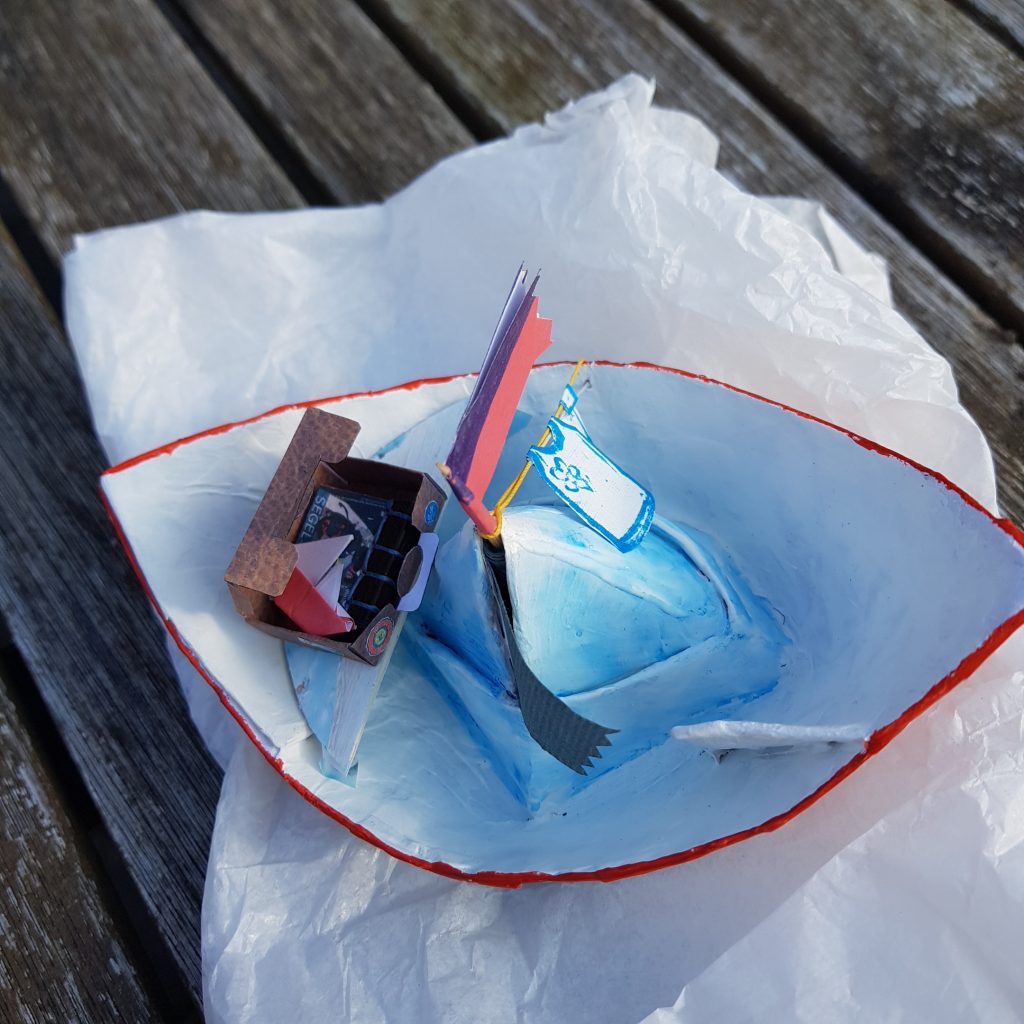
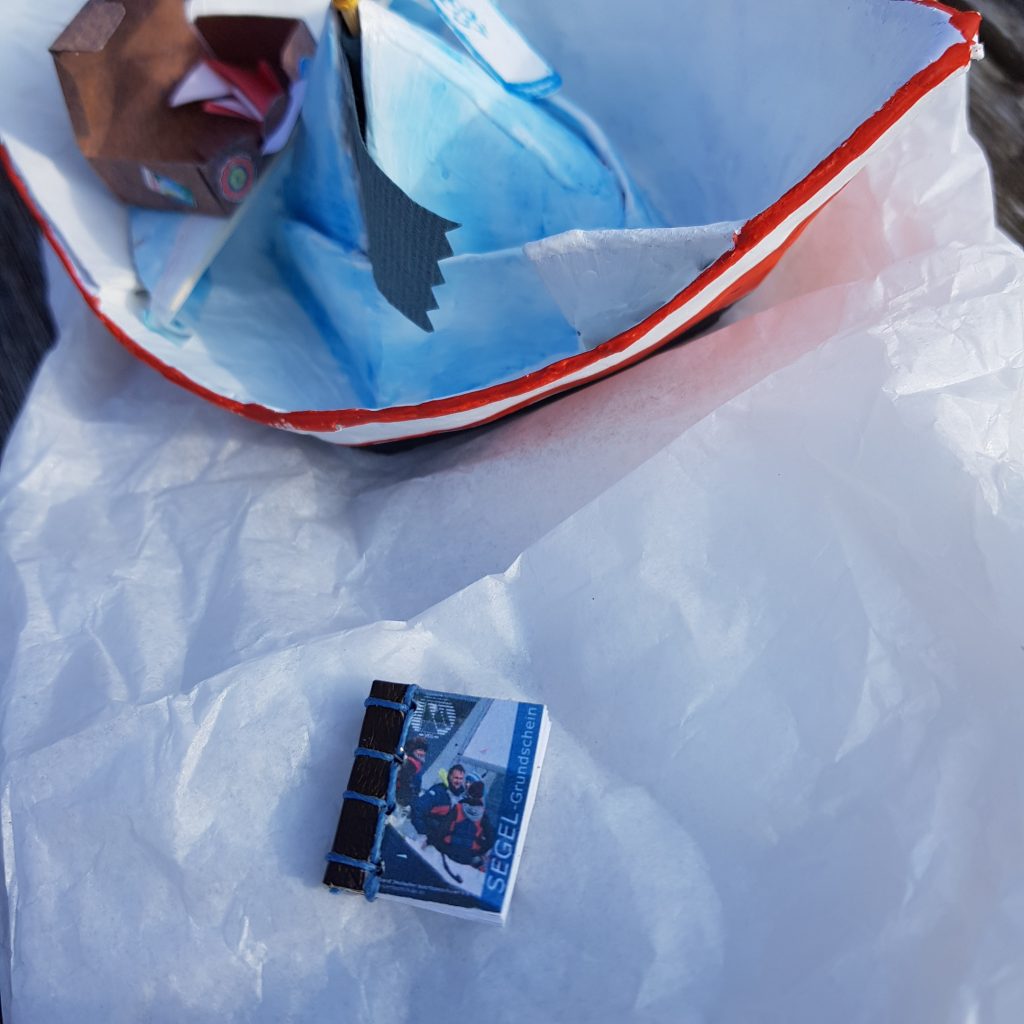
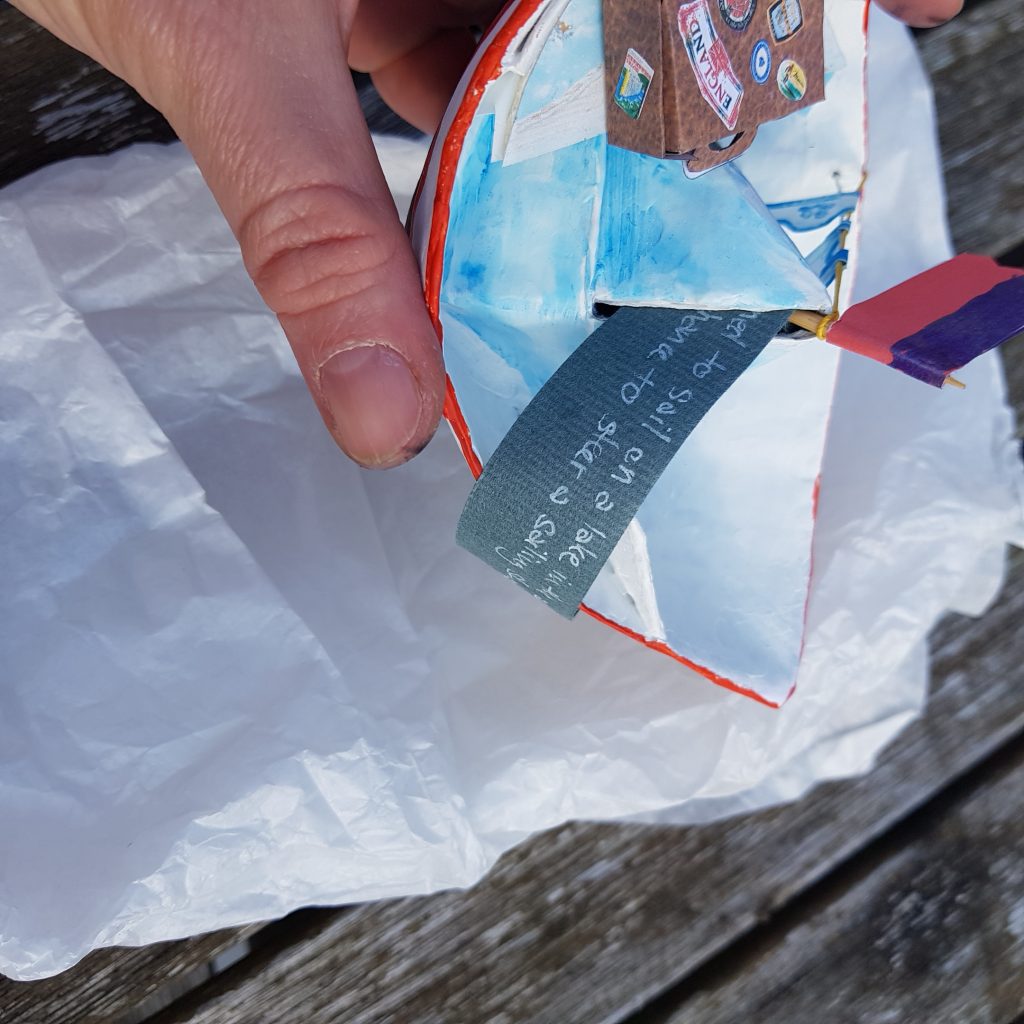
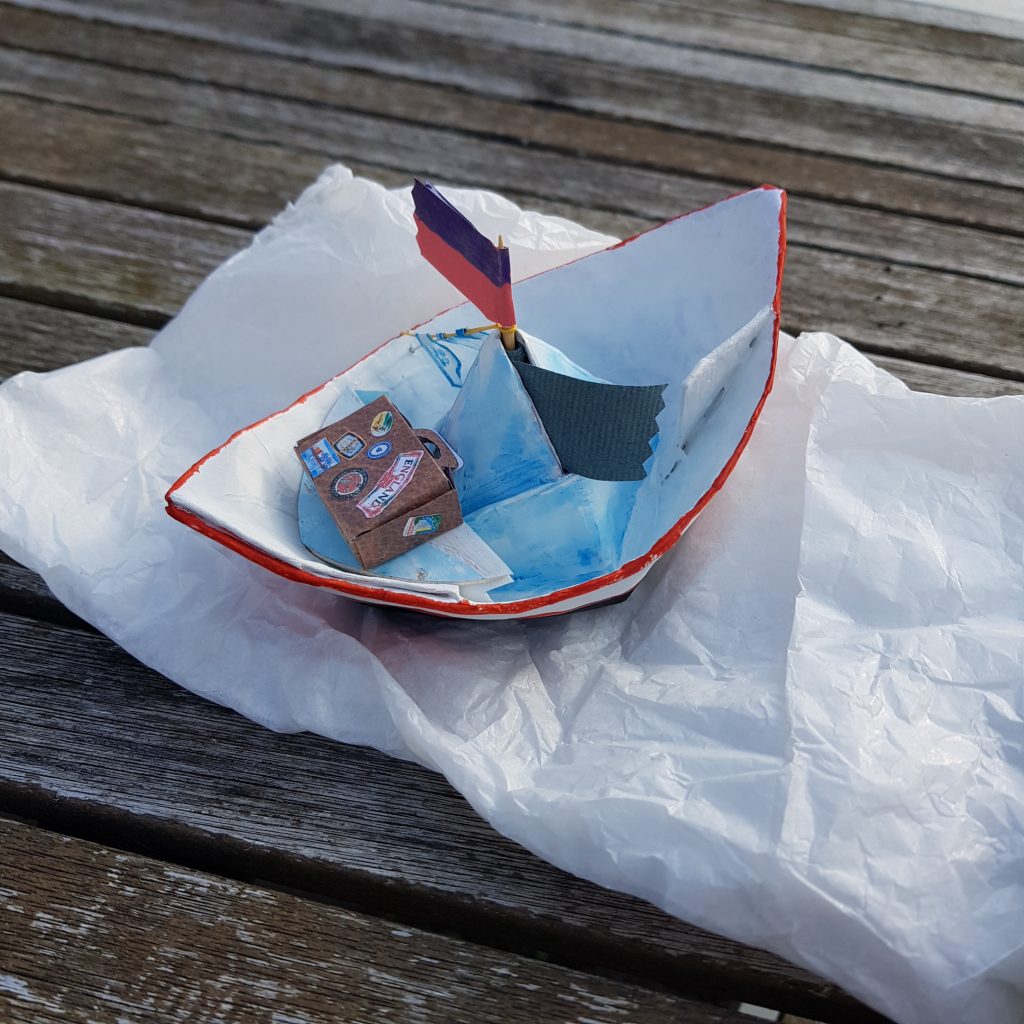
My larger bodies of work recently were dealing with migration background, pregnancy. But picking one work out of these bodies of work feels dated, and maybe a bit out of context. And so I decided to show you the book I made for the first Notts Book Arts Swap in 2023. A fun, stand alone project that doesn’t carry any emotional heaviness, but is quite typical of the sort of thing I would make, I think. It consists of a paper boat that I stabilised using paper-mache. I added a little bench, and a suitcase that holds on to the bench with a magnet. The suitcase opens and contains a miniature version of the textbook I used when I took part in a simple sailing course and a few other small items, like mini-mini paper boat. The sail of the big boat is topped with a flag which in fact is another book, it’s the dowel of a scroll, which can be unwound to show a short sentence. I also added rigging, made stamps and stamped some clothes that I cut out and hung on these ropes.
Which book by another artist do you wish you had made or thought of? Oh, that happens so many times when I look at other people’s work! I am going to say Amy Sterly, Language Blend. It was part of the last exhibition that I curated, and I instantly thought: gosh, I wish I had thought of that! She used differently discoloured pages of — I think it was a dictionary, but might have been a different book. She glued darker pages together to form a concertina, and cut them into strips, and wove in less discoloured pages, making the letters and words mix, creating a blend of colours and words and language….
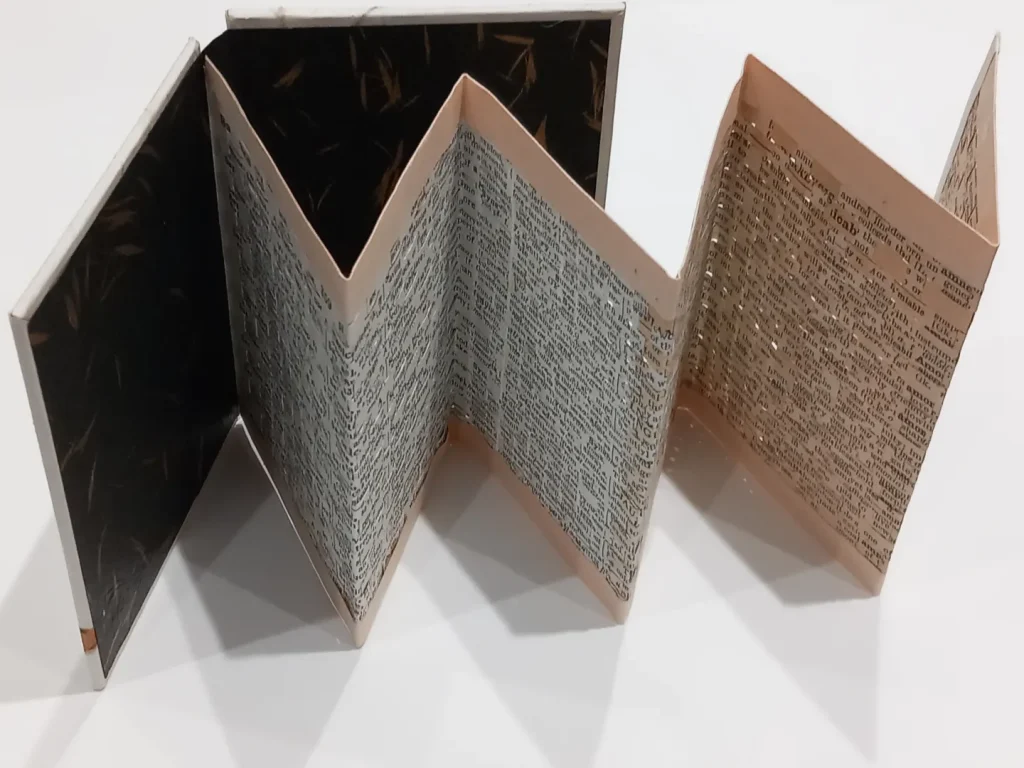
Language Blend by Amy Sterly
Which books on bookbinding, making, printing etc do you most use and why?
Ooh, I have so many! I like to look through them and find something I have never tried before. I hardly use the same book for the same thing twice, so that’s a hard question to answer! I first learned bookbinding from Zeier, Schachtel, Mappe, Bucheinband. This is an excellent introduction to the craft of bookbinding. There is an english language version: Books, Boxes & Portfolios: Binding, Construct and Design, Step-By-Step, ISBN: 978-0830634835 I also like the K. Smith books on non-adhesive binding (https://keithsmithbooks.com) One of the most valuable books for me has been J.A. Szirmai, The Archaeology of Medieval Bookbinding. I have an Ashgate reprint ISBN 978-0-85967-904-6, but there are newer reprints out there now. I found a rather more affordable paperback just now when I searched with an ISBN 978-1138247321 In the direction of book art and more playful structures, the best of all in my view is Alisa Golden, Making handmade Books. 100+ Bindings Structures & Formsm ISBN 978-1-60059-587-5 But there are so many more! I recommend anyone to look at actual books, sift through the coffee table books and online galleries to see what kind of structure you’re interested in and what kind of thing you like to do — and find a book then. The book arts are such a wide field and many people do such different and equally interesting stuff that it’s hard to point to one thing.
What was your biggest book-making disaster? I am blessed with a memory like a sieve that loses all the bad things. I honestly can’t remember them. But there were certainly many. Maybe the one where I tried to print on leather? It worked twice and then I ruined my (rather expensive) printer. It can be a frustrating business. I always say: “Rule No. 1 Don’t bleed on your books” because it happens, and blood is hard to be turned into something that turns out to be better than the original concept anyway.
What are you currently working on? Many small things rather than a bigger body of work: I am practicing gelli printing and thinking about how to incorporate that into books (my latest zine Shakespeare Tidied Up already does that to an extent). I have a long term project sitting on my desk that I keep thinking about again and again which is centred around the Johannisfriedhof in Leipzig, a cemetary in Leipzig where I spend a while sketching and copying letters and layouts in 2009. I played with the material in this way and that, but can’t quite find the right thing to do with it. I have a bunch of clear plastic sheets (small, cut from yoghurt containers) that I want to turn into a book… many small bits I still have to play with. The biggest thing currently it hammering out a concept for the next book arts festival/thing
Do you like to work with music playing? What kind of music works best for you? I do sometimes. The most played artists while working are Zoe Keating (Cello and a loop pedal) and A la poupee & the chine-collees who are making songs about printmaking (you can find both on bandcamp).
What is YOUR definition of an artist’s book? A piece of book art is a piece of art, that has the form of a book. Just like a piece of painting art has the form of a painting. For one and the other there are many different styles and forms that can take. And artist’s book is a book that belongs to an artist.
What is your favourite book-making tool? What is your craft knife of choice? Bonefolder
If you received an Arts Council grant for £30,000, what would you spend it on? And if it was £500? For £30,000 I would build the next Book Art Festival with an exhibition, a fair, and a workshop programme and possibly a residency built in, preferably for young people. — So in short, I would spend the money to employ people to spread the love of bookbinding. For £500 I would organise a book arts fair.
If no-one ever saw them, would you still make books? Yes. many of my books are not seen, and I started to make them before I knew there was such a thing as book art. I started out making what I called “books with holes”, and a friend who is an artist said that it reminded her of tunnel books — I had never heart of that before. Then I started to search for the term and discovered the world of book art. So yes, I did and definitely would continue to make books just for myself.
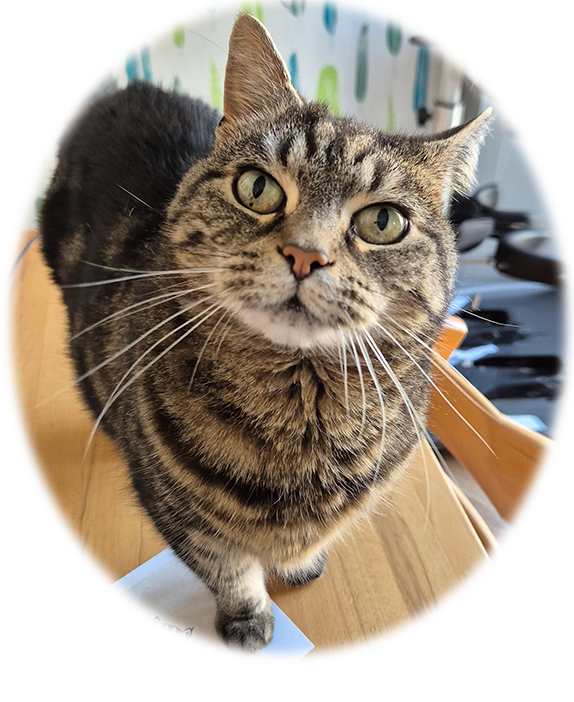
What help does your pet provide in the studio (are they allowed in?) I do have a cat, but she’s not allowed in the studio as she likes to gnaw on paper. But she does still provide lots of inspiration.